Why Systems Alone Won’t Scale Your Home Service Business
Introduction
The home service industry is obsessed with systems right now.
And to be clear, that’s not a bad thing.
Everywhere you look, business owners are being told they need:
SOPs
ServiceTitan workflows
EOS
accountability charts
KPIs
scorecards
automations
meeting cadences
organizational charts
The message is simple:
“Install the right systems, and your business will scale.”
While there’s some truth in that, there’s also a major problem.
Despite all of these systems, many home service businesses still struggle with operational chaos, poor accountability, inconsistent execution, team drama, owner burnout, shrinking margins, and constant firefighting.
Why?
Because systems alone do not build great companies. Leadership does.
And eventually, every business becomes a reflection of the thinking and leadership behind it.
Systems Are the Framing, Not the Foundation
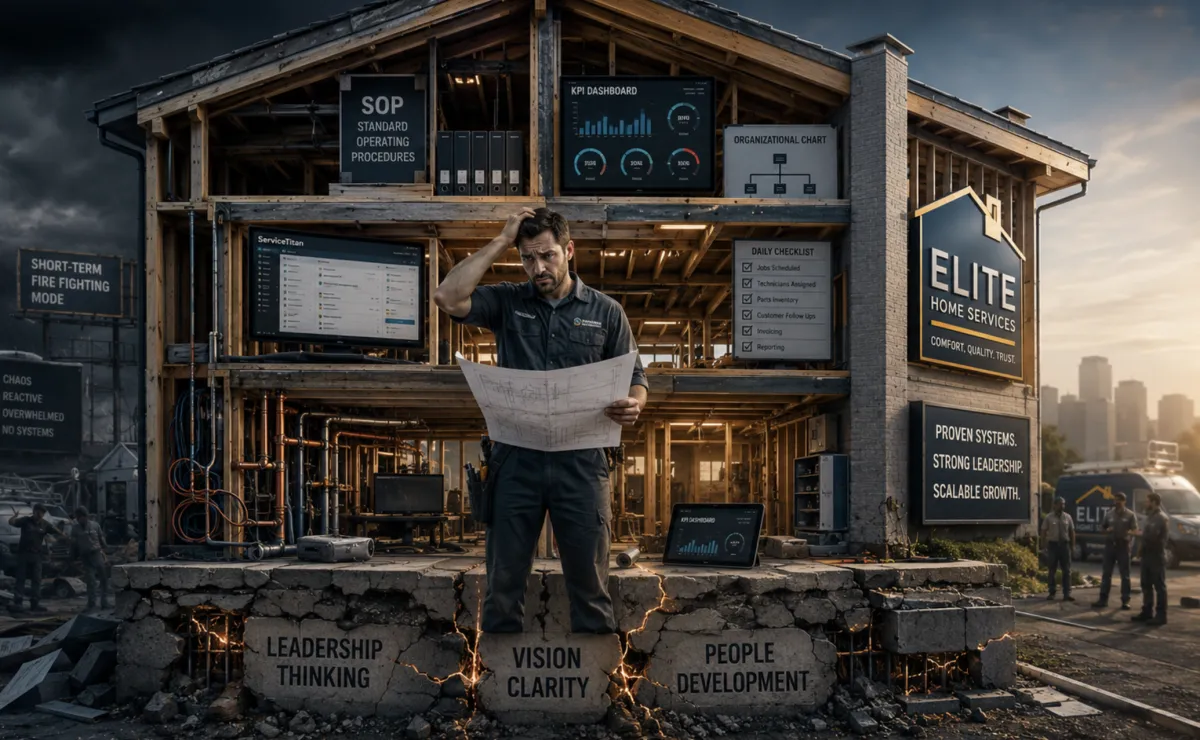
I often explain business growth using the analogy of building a house.
The systems and operational structure of your business are the framing: SOPs, KPIs, workflows, meeting structures, org charts, and operational processes.
They create stability and structure.
Your people systems are the plumbing and electrical: communication, hiring, delegation, accountability, and leadership development.
Your marketing and branding are the finish work: trucks, wraps, ads, websites, social media, and branding.
But none of those things matter if the foundation underneath the business is weak.
And the foundation in this case is the owner's thinking and leadership.
That foundation includes:
decision-making
emotional discipline
strategic thinking
leadership maturity
standards
accountability
self-awareness
long-term vision
Most businesses don’t collapse because the finish work was bad.
They collapse because the foundation underneath the structure was never strong enough to support growth.
The Real Reason Systems Break Down
I’ve worked with business owners who had great software, strong operational systems, dashboards, processes, scorecards, and training manuals in place.
And yet the business still drifted back into chaos.
Why?
Because systems cannot outperform the leadership behind them.
If you, as a leader:
avoid difficult conversations
tolerate poor accountability
make emotional decisions
change direction constantly
fail to install or uphold standards
rescue employees instead of developing them
micromanage everything, and
operate reactively
…the systems eventually erode.
The problem wasn’t the SOP; it was the leadership discipline required to sustain it.
A system is only as strong as the standards the leader consistently upholds.
The Technician Trap
This is where many home service business owners get stuck.
Most owners built their companies through hard work, grit, technical expertise, responsiveness, and personal problem-solving.
Those traits helped them survive and grow.
But eventually, the very skills that built the business become the bottleneck to scaling it.
Because the skills required to build a successful trade career are not the same skills required to build a scalable company.
At some point, business growth stops becoming a technical problem.
It becomes a leadership problem.
Many owners are still trying to solve CEO-level challenges with technician-level thinking.
And that shows up as:
inability to delegate
reactive leadership
inconsistent accountability
emotional pricing decisions
poor hiring choices
owner dependency
lack of strategic planning
constant operational chaos
The business outgrows the leadership approach that originally built it.
The Three Stages of Business Growth
In my experience, most owners move through three stages.
1. Technician Thinking
This is survival mode.
The owner is doing everything, solving every problem, reacting constantly, and is heavily involved in daily operations.
At this stage, hard work is the primary growth strategy.
2. Operator Thinking
This is where systems begin to emerge.
The owner starts implementing processes, tracking KPIs, building structure, improving consistency, and creating accountability.
This is where many consultants and coaches stop.
And systems absolutely matter here.
But systems alone are not enough to create a scalable, self-sustaining organization.
3. CEO Thinking
This is where true scale begins.
The owner evolves from worker to leader
CEO thinking looks like:
strategic decision-making
leadership development
organizational design
long-term vision
financial clarity
operational discipline
building leaders
creating culture intentionally
Technicians build jobs.
Operators build systems.
CEOs build organizations.
Why Some Businesses Scale Faster Than Others
Place a high-level operator who has built elite businesses into an average company with weak systems, inconsistent accountability, unclear culture, and reactive leadership.
Do you think they would struggle for long?
Probably not.
Because elite leaders think, prioritize, communicate, and uphold standards differently.
Not to mention hiring, decision-making, and leadership.
Within 12–18 months:
the culture changes
accountability improves
systems strengthen
leaders emerge
operational discipline increases
profitability improves
Why?
Because the real competitive advantage was never just the systems.
It was the quality of thinking behind them.
Systems Matter. Leadership Multiplies Them
To be clear, I believe deeply in systems.
You need processes, accountability, KPIs, and operational structure.
Other key elements include financial visibility, communication rhythms, and organizational clarity.
But systems are multipliers.
They multiply the quality of the leadership behind them.
Strong leadership with strong systems creates scale.
Weak leadership with strong systems creates sophisticated chaos.
That’s why two companies can implement the exact same software, operating system, or playbook—and get completely different results.
The Real Goal Isn’t Better Systems
The real goal is to become the kind of leader capable of building and sustaining a scalable business.
Because eventually:
the growth of the business becomes the growth of the owner
the organization reflects the thinking of leadership
operational success becomes leadership success
At some point, the question is no longer:
“What system should I install?”
The question becomes:
“Who do I need to become to lead this business at the next level?”
That is the real transition from technician to CEO.
And for most home service business owners, that shift changes everything.
If you are ready to make the shift from technician to operator to CEO, let's talk.
